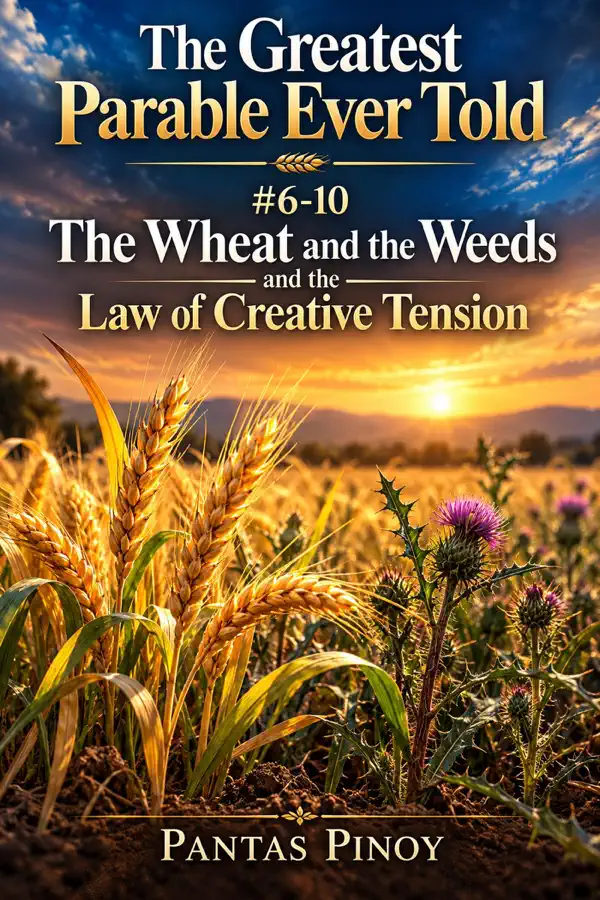
The Wheat, the Weeds and the Law of Creative Tension
Few of the parables attributed to Jesus confront the problem of an imperfect world as directly as the Parable of the Wheat and the Weeds. A farmer carefully plants good seed, yet something undesirable appears alongside the crop. The servants, seeing the threat, naturally want to remove it. Why should the farmer permit the weeds to remain? Why not eliminate the problem immediately and allow the wheat to grow without interference?
These questions reach beyond agriculture. They touch the enduring human desire for a world in which goodness flourishes without obstruction, justice prevails without resistance, and everything undesirable can be removed without consequence.
We want a universe without suffering, a society without injustice, a life without disappointment, and a mind without contradiction. We imagine that perfection would be achieved if only every obstacle could be eliminated.
Yet reality presents us with a different picture. The universe is dynamic, not static. Creation unfolds through interactions among forces that sometimes cooperate and sometimes compete. Stability exists alongside change, construction alongside destruction, and cooperation alongside competition. Life flourishes in environments that are neither completely uniform nor entirely predictable.
Viewed through the philosophical lens of cosmic evolution, the Parable of the Wheat and the Weeds offers an opportunity to examine what we might call the Law of Creative Tension: the principle that opposing forces, competing possibilities, and disruptive changes can sometimes contribute to the emergence of new forms of order.
This does not mean that evil is necessary in every circumstance, that suffering should be welcomed, or that injustice must be tolerated. Nor does it mean that every conflict produces something beneficial. Rather, it suggests that the relationship between order and disorder is more complicated than our desire for a perfectly controlled world allows us to imagine.
The presence of weeds does not automatically mean that the field has failed. But neither does their presence make them desirable.
The challenge is to understand when tension becomes creative, when it becomes destructive, and when intervention is necessary to protect what is growing.
Book Info
No download link available yet. You can .
Related Books
Similar recommendations you might enjoy